





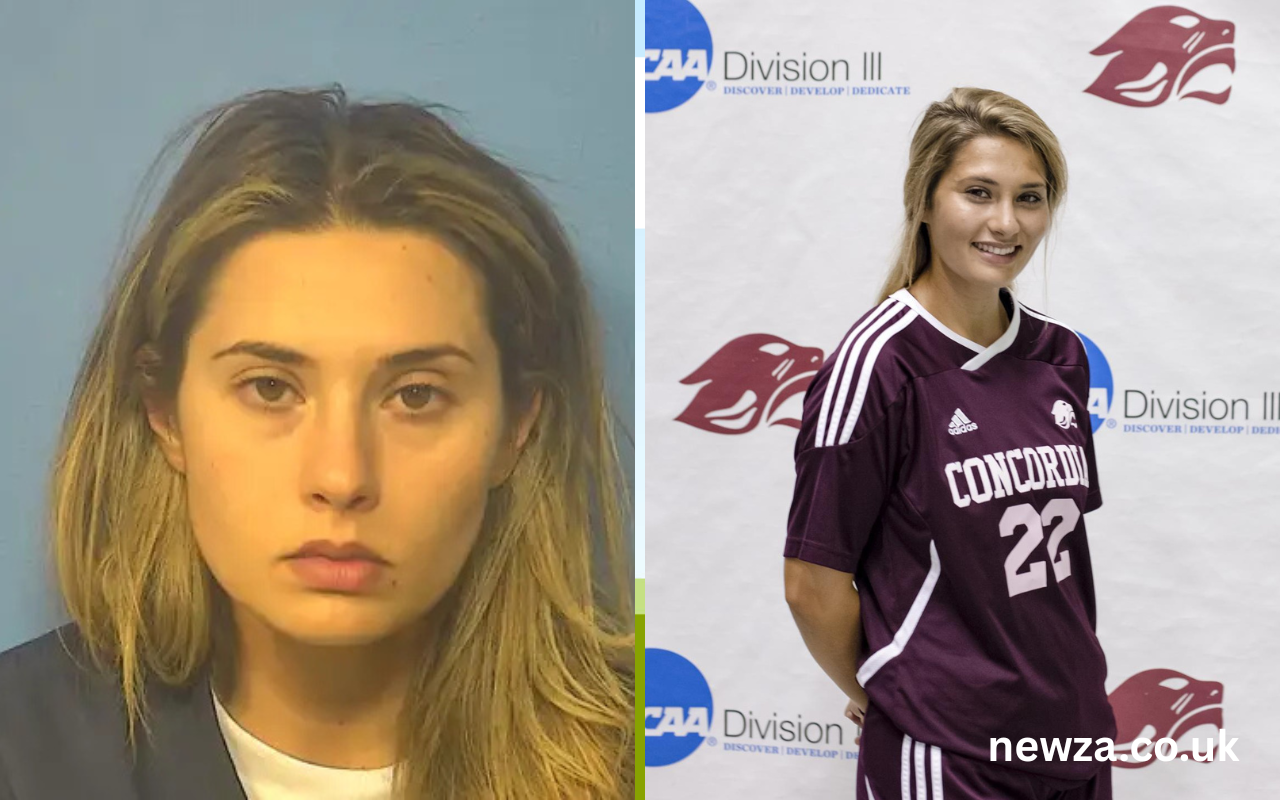
The Christina Formella Case: From Special Education Teacher to 55 Felony Charges
The quiet suburban rhythm of Downers Grove, Illinois, was broken forever on a routine March morning in 2025. Christina Formella, a thirty-year-old special education teacher and soccer coach at Downers Grove South High School, was pulled over during a standard traffic stop. Instead of receiving a simple ticket, she was handcuffed and taken into custody on charges that would soon make national headlines. The initial charges were severe, including aggravated criminal sexual abuse and criminal sexual assault of a minor, sending immediate shockwaves through a community that prided itself on excellent schools and safe neighborhoods. Parents who had dropped their children off that morning never expected that a trusted educator was the one being led away in handcuffs.
For the students and staff, the news was almost impossible to process. Christina Formella had been a familiar face in the hallways since the 2020-21 school year, specifically hired to work with some of the most vulnerable students in the district as a special education teacher. Her role required patience, trust, and a high degree of responsibility, qualities that made the allegations feel like a deep betrayal. She was also a coach for both the boys and girls soccer teams, which meant she had unsupervised access to students during early morning practices, late games, and private tutoring sessions. The contrast between her professional reputation and the criminal charges created a crisis of trust that the school district is still struggling to repair.
Law enforcement moved quickly, recognizing the potential for more victims. While the initial arrest focused on one specific student, detectives immediately began confiscating digital devices, including Christina Formella’s cell phone and school-issued laptop. They suspected that the case was larger than a single incident, and their instincts would prove tragically correct. The arrest was only the first chapter in a legal saga that would eventually involve fifty-five separate felony counts, a hidden memoir, and explicit text messages that painted a disturbing picture of manipulation and control. The quiet suburb had become the center of one of the most disturbing educator misconduct cases in recent Illinois history.
The Grooming Process That Started on the Soccer Field
Court documents later revealed that the relationship between Christina Formella and the teenage victim did not happen suddenly or by accident. Prosecutors from the DuPage County State’s Attorney Office argued that the teacher engaged in a calculated and methodical grooming process that began in January 2023. At that time, the boy was only fourteen years old and a member of the soccer team she coached. Grooming often starts with seemingly innocent attention, extra coaching tips, and private conversations that create a special bond between the adult and the minor. Parents and school administrators often miss these early warning signs because the interactions look like standard mentorship.
The situation took a critical turn when the student suffered a collarbone injury that kept him off the field. Christina Formella reportedly used this vulnerable moment to offer private tutoring sessions before regular school hours began. This arrangement effectively isolated the teenager from his peers and placed him alone in a classroom with an adult who held authority over his grades and athletic standing. Police investigators found that she initially used the official school messaging platform to communicate, which is monitored by the district. However, she eventually shifted to personal text messages and even online games like Eight Ball Pool on their phones to build rapport and hide their conversations from school filters.
By December 2023, the grooming had escalated to physical acts. Prosecutors allege that during a morning tutoring session, Christina Formella locked the classroom door, and the pair engaged in sexual acts for the first time. The boy was fifteen years old at this point, while Formella was twenty-eight. This seven year age gap is significant in Illinois law, where a teacher holds a position of trust and authority that makes any sexual contact with a student a felony, regardless of the student’s age. The locked door was a deliberate act, showing intent and awareness that what was happening was illegal. The coaching relationship that began with soccer drills had transformed into a criminal conspiracy of silence.
Fifty Five Counts and the Shocking Grand Jury Indictment
What initially appeared to be a handful of charges quickly exploded into a legal avalanche as investigators dug deeper into Christina Formella’s digital footprint. She was first charged with two counts of aggravated criminal sexual abuse and one count of criminal sexual assault, which alone carried significant prison time. However, detectives were not satisfied with the initial scope of the investigation. They continued to analyze text messages, location data, and deleted files from her phone, uncovering a pattern of behavior that suggested the abuse was not a one time mistake but a repeated, deliberate course of action.
In June 2025, a grand jury returned a superseding indictment that added fifty two additional charges, bringing the total to an astonishing fifty five felony counts. These new charges included multiple counts of criminal sexual assault, aggravated criminal sexual abuse, indecent solicitation of a child, and specific charges related to grooming a minor. The sheer number of charges reflects the frequency of the alleged encounters. Prosecutor Jaclyn McAndrew stood before the court and made a stunning claim, alleging that Christina Formella did not abuse the teen just a few times, but engaged in sex with him at least forty five separate occasions. McAndrew described the educator as unbelievably conniving and unbelievably controlling, painting a picture of a predator who used her authority as a shield.
The locations of these alleged acts were particularly disturbing to parents in the community. Prosecutors claim that the abuse did not only happen in her locked classroom but also took place at her home during school hours. This meant that Christina Formella was allegedly leaving school grounds with a minor student or having the student visit her residence while she should have been teaching. The brazen nature of the alleged crimes suggested a level of confidence that comes from believing one will never be caught. If convicted on all fifty five counts, Formella faces up to sixty years in prison, which for a thirty year old woman would effectively be a life sentence.
The Hidden Memoir and Explicit Texts Found on Her Phone
Perhaps the most damaging piece of evidence against Christina Formella is not a witness statement or a confession to police, but her own written words discovered hidden in her phone’s Notes application. When law enforcement executed a search warrant on her digital devices, they found a document she had titled as a memoir. Far from being a simple diary of daily events, the entries allegedly detailed a toxic, obsessive, and possessive relationship with the minor student. In one passage, she expressed rage that the teenager had cheated on her, calling him disgusting and writing that they would never ever be together again. These are not the words of an innocent educator being framed, but rather the language of a jealous partner.
The memoir also contained a section titled Manifestations, which read like predictions or demands for the future. In this section, Christina Formella allegedly wrote that the boy would try to fix things with her, claiming that she was the best thing he would ever have. This type of language reveals a disturbing power dynamic where the adult teacher saw herself as the ultimate prize in a relationship with a child. Alongside these journal entries, police recovered explicit text messages that left little room for interpretation. One of the most incriminating texts allegedly sent by Formella read, I love having sex with you. These messages provided direct evidence of sexual contact and emotional attachment.
When confronted with this mountain of digital evidence, Christina Formella offered a defense that raised eyebrows in the courtroom. She claimed the student had stolen her phone, sent the explicit texts to himself, and then deleted them from her device to frame her. This defense requires the court to believe that a teenage student was sophisticated enough to steal a teacher’s phone without getting caught, craft convincing fake messages, and then plant a detailed memoir in her notes app without her knowledge. Regarding the memoir, she asserted it was merely a journal about her husband and had nothing to do with the student. Legal experts have noted that this defense is weak given the timestamps and context of the entries.
The Defense Strategy I Am Being Framed for Being Good Looking
Christina Formella’s legal strategy has been as unconventional as it is controversial in legal circles. In police bodycam footage released to the public and subsequent court hearings, she has consistently denied ever having sex with the victim. Instead, she has pivoted to a defense centered on her physical appearance and alleged victimization by a sexist legal system. When first questioned by officers, she allegedly told them that the student was a stalker who was targeting her because everybody comes after her because she is good looking. This argument attempts to flip the narrative, suggesting that her attractiveness makes her a target for false accusations rather than a perpetrator of abuse.
This narrative has been amplified and supported by her family as the case garnered international attention. A representative for the Formella family issued statements claiming she is the victim of sexist scrutiny and gender based persecution. The family argued that the public discourse focuses on her appearance and private life as if those details bear on guilt or innocence. They lamented that she is being hunted by content creators and media personalities, turning her into a caricature of a predator and an unfaithful wife. This defense has polarized observers, with some supporting the idea of media bias against attractive women in high profile cases, while prosecutors argue it is a blatant attempt to distract from the overwhelming physical and digital evidence.
Legal analysts following the case have noted that this defense strategy is risky because it does not directly address the evidence. The memoir, the text messages, and the locked classroom door are not explained by a claim of being too good looking. Furthermore, the defense’s focus on sexism ignores the fact that the alleged victim is a male teenager. Prosecutors have pointed out that if the genders were reversed and a male teacher made similar claims about a female student, the public reaction would be universally condemnatory. The courtroom has become a battle not just over facts, but over narratives, with Christina Formella attempting to write herself as the victim of a jealous teenager and a biased society.
A Supportive Husband and a Banned Marital Home
Throughout the legal ordeal, Christina Formella has had one consistent supporter by her side, her husband Michael. The couple married in a lavish ceremony on the Amalfi Coast in Italy just nine months before the allegations became public, a detail that has added a tragic irony to the proceedings. Despite the graphic nature of the charges, including allegations that the abuse occurred in the home they shared while Michael may have been at work or asleep, he has attended every single court hearing. He often holds his wife’s hand in the courtroom gallery, providing a visible display of marital solidarity that has been captured by news cameras and dissected by commentators.
Michael has publicly stated that he was completely blindsided by the accusations, claiming he had no knowledge of any relationship with the student. This assertion of ignorance is crucial to the defense, as it supports Christina Formella’s claim that the memoir was about him and not the teenager. However, it also raises difficult questions about how a husband could be unaware of a significant relationship occurring in his own home during school hours. The couple’s willingness to appear united in public has not translated into a normal living situation, however, because the conditions of pretrial release have physically separated them.
As a condition of her release, Judge Mia McPherson ruled that Christina Formella must stay at least five thousand feet away from the alleged victim. Unfortunately for the teacher, her marital home fell well within that restricted buffer zone. Consequently, she was forced to move out of the house she shared with her new husband and reside with her parents in a different home several miles away. In a bid to return to her spouse, Formella’s legal team requested the buffer zone be reduced to twenty five hundred feet, arguing that the distance was an undue hardship on her marriage. The judge denied this motion, meaning the separation from her husband remains in place as she awaits trial, a lonely consequence of the allegations she faces.
The Aftermath Resignation and the Yearbook Controversy
The professional fallout for Christina Formella was swift and absolute, leaving no room for a quiet return to teaching. Following her arrest and the surfacing of the charges, she was immediately placed on administrative leave by Community High School District Ninety Nine, a standard procedure when an educator is accused of a crime against a student. However, rather than face a lengthy and public termination hearing that would force the district to detail the evidence against her, Formella chose to resign from her position. In a move that signifies a permanent end to her teaching career, she voluntarily relinquished her professional educator license to the Illinois State Board of Education in June 2025.
This voluntary surrender of her license is legally significant because it bars her from ever teaching in an Illinois public school again, effectively closing the chapter on her life as an educator. It is also an admission, in a legal sense, that fighting to keep the license would be futile given the evidence against her. While she retains the right to apply for a license in another state, the public nature of this case and the fifty five felony charges make that extremely unlikely. Any school district conducting a basic background check would discover the pending criminal case and the surrendered Illinois license, ending any employment discussion immediately. The teaching profession has effectively expelled Christina Formella.
Yet, a bizarre and hurtful controversy lingered in the hallways of Downers Grove South High School long after her resignation. When the school distributed its 2024-2025 yearbook, students and parents were shocked to find Christina Formella’s face inside not once, but three separate times. Her professional headshot appears alongside group photos of the boys soccer team and the junior varsity girls soccer team that she coached during the school year. The school district explained that the yearbooks had gone to print in March, precisely as the scandal was breaking, making it impossible to remove her images without halting the entire distribution and incurring massive printing costs. For many victims and parents, seeing the accused abuser immortalized in a book meant to celebrate student achievements added a deep insult to an already grievous injury.
The Legal Road Ahead and Potential Prison Time
As Christina Formella awaits her next court date in the DuPage County Judicial Center, the stakes could not be higher for everyone involved. The case has moved past the initial shock of the arrest and the surprise of the indictment and has entered the procedural grind of pretrial motions. One of the key legal battles was fought over her detention status. Prosecutors argued that Christina Formella posed an ongoing threat to the community, citing her manipulative behavior as documented in the memoir and the fact that she lived within walking distance of the school where the victim was still a student. They pushed for her to be held in custody under the Illinois SAFE T Act, which allows for pretrial detention in cases involving serious felonies.
However, Judge McPherson denied the prosecution’s motion to detain her. While calling the allegations horrifying in nature and shocking to the conscience of the court, the judge determined that the general public was not at risk and that strict conditions were sufficient to ensure safety while she awaits trial. Those conditions include the ankle monitor that tracks her every movement, the no contact order that forbids any communication with the victim or his family, and the five thousand foot buffer zone that has forced her out of her own home. The judge has scheduled her next hearing for later this year, where the defense is expected to continue fighting the admissibility of the memoir evidence, arguing that it is prejudicial and violates her privacy rights.
If a plea deal is not reached between the defense and the DuPage County State’s Attorney, the trial will commence with jury selection. The prosecution has indicated it will call the victim to testify, as well as forensic experts who can authenticate the text messages and the memoir. The defense will likely continue to argue that the student was a stalker who framed a popular teacher. Given the fifty five charges stacked against her, legal experts suggest that a conviction on even half of those counts could very well lead to a sentence that keeps her behind bars for the majority of her life. The Illinois Department of Corrections has already been notified to prepare for a potential high profile inmate. The former special education teacher who once helped vulnerable children now faces a future defined by prison walls and the permanent label of convicted sex offender.