




The Dick Van Dyke Show: How a Black-and-White Sitcom Became the Gold Standard for Television Comedy
The Brilliant Origins of a Television Masterpiece
The story of how The Dick Van Dyke Show came to exist is almost as entertaining as the show itself. In the late 1950s, comedian and writer Carl Reiner was performing on The Steve Allen Show when he began jotting down humorous anecdotes about his time as a head writer for Your Show of Shows, the legendary variety program starring Sid Caesar. These notes eventually became a novel called Something Funny Happened on the Way to the Shore, but Reiner quickly realized the material was better suited for television. He envisioned a show about a comedy writer balancing the absurdities of show business with the everyday joys and challenges of family life. The working title was Head of the Family, and Reiner originally planned to star as the lead character himself. However, after filming a pilot that he later admitted was too stiff and self-centered, Reiner made the courageous decision to recast the lead role and start over from scratch.
Enter Dick Van Dyke, a relatively unknown but highly respected stage actor who had just won a Tony Award for his performance in Bye Bye Birdie. Reiner saw Van Dyke perform and immediately recognized that he had found his Rob Petrie. Van Dyke possessed an extraordinary combination of physical grace, boyish charm, and impeccable comic timing that Reiner knew would bring the character to life. The chemistry between Van Dyke and his new co-star, a little-known actress named Mary Tyler Moore, was instantaneous and electric. Moore had been working primarily in small television roles, often playing secretaries, but Reiner saw something special in her ability to convey intelligence, vulnerability, and wit. CBS executives were initially hesitant about the show, fearing that audiences would not connect with a behind-the-scenes look at television writing. Reiner and producer Sheldon Leonard fought hard for the series, and CBS finally greenlit production. When The Dick Van Dyke Show premiered in the fall of 1961, it was clear that television had just witnessed the birth of something extraordinary.
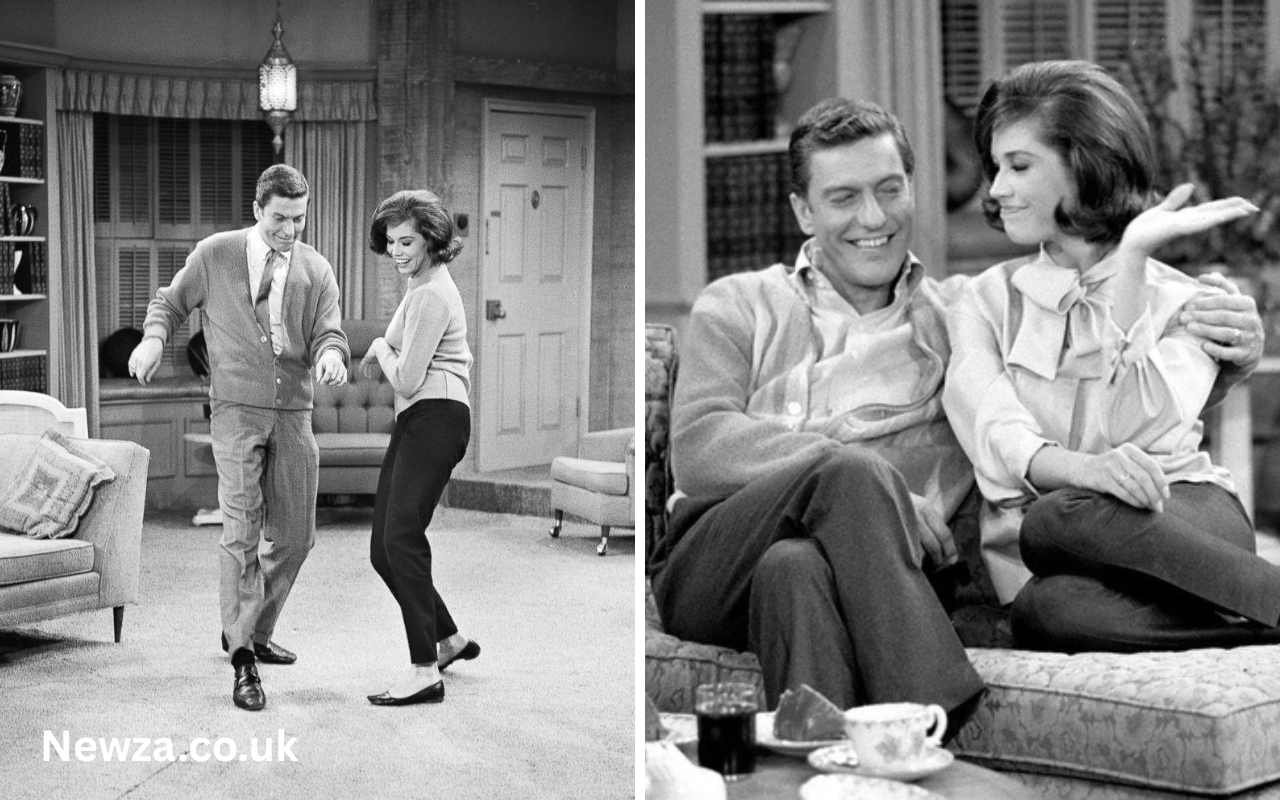
The show’s setting in New Rochelle, New York, was a deliberate choice that reflected the postwar American dream of suburban comfort and upward mobility. Rob and Laura Petrie lived in a modest but stylish home with their young son Ritchie, and the show took great care to make their living space feel warm and lived in. The famous living room set, with its curved couch, modern art, and of course the dreaded ottoman, became one of the most recognizable environments in television history. Carl Reiner insisted on high production values and realistic set design because he wanted viewers to believe that these people could be their neighbors. This attention to detail extended to the wardrobe as well. Mary Tyler Moore’s capri pants caused a minor sensation because no leading lady on television had dressed so casually and comfortably before. The network received letters complaining that Laura Petrie wore pants too often, but Moore and Reiner refused to change, understanding that the informality was essential to the character’s authenticity. That small act of creative defiance became symbolic of the show’s entire approach, which prioritized truth and relatability over outdated conventions.
The Unforgettable Characters Who Felt Like Real People
At the heart of The Dick Van Dyke Show was the marriage between Rob and Laura Petrie, which remains one of the most lovingly portrayed relationships in television history. Unlike many sitcoms of the era that relied on nagging wives and bumbling husbands for easy laughs, Rob and Laura genuinely adored each other. They teased each other affectionately, supported each other’s ambitions, and worked through disagreements with respect and humor. Dick Van Dyke and Mary Tyler Moore developed a real-life friendship that translated beautifully on screen, and their scenes together crackled with warmth and playful energy. Whether they were trying to assemble a new piece of furniture, dealing with a mischievous pet, or navigating a rare moment of jealousy, the Petries felt like a real couple. This authenticity broke new ground for television, which had previously depicted marriage as either a saccharine fantasy or a comedic battlefield. Laura was not just a housewife; she had dreams and opinions and a sharp wit that could match Rob’s own. Rob was not a distant, authoritative father; he played with Ritchie, admitted when he was wrong, and often relied on Laura’s advice and perspective.
The workplace characters were equally well drawn and essential to the show’s success. Buddy Sorrell, played by the legendary Morey Amsterdam, was a fast-talking joke machine whose one-liners could cut through any tense situation. Amsterdam was a veteran of vaudeville and the Borscht Belt comedy circuit, and he brought decades of experience to the role. His character was loosely based on the real-life comedy writer Mel Brooks, who had worked alongside Carl Reiner on Your Show of Shows. Rose Marie’s Sally Rogers was an even more groundbreaking character, a single female comedy writer who was just as sharp and ambitious as her male colleagues. Sally openly longed for marriage and children, but she never compromised her career or her dignity to get there. She was funny, lonely, proud, and deeply competent, a combination that made her one of the most complex and beloved supporting characters in television history. Richard Deacon played Mel Cooley, the beleaguered producer who served as the frequent target of Buddy and Sally’s insults. Deacon’s portrayal of Mel as a decent man trapped between the writers and the demanding star Alan Brady added a layer of pathos to the comedy. Together, this ensemble created a workplace dynamic that felt authentic, lived in, and endlessly entertaining.
The unseen star of the show was Alan Brady, the egomaniacal host of the fictional variety program that employed Rob, Buddy, and Sally. Carl Reiner himself played Brady, initially keeping his face hidden or shooting him from behind to preserve the joke that the character was too famous to be seen fully. When Reiner finally revealed Brady’s face in a memorable third-season episode, it was a brilliant payoff that demonstrated the show’s willingness to play the long game with its audience. Brady was a hilarious parody of real-life television personalities like Milton Berle and Jackie Gleason, a man so consumed by his own celebrity that he demanded constant praise and threw tantrums over the smallest slights. The relationship between the writers and Brady provided endless comic material, as Rob and his colleagues navigated the absurd demands of a star who had no idea how the real world worked. By creating such a rich and varied cast of characters, The Dick Van Dyke Show ensured that every episode offered multiple layers of comedy, from the physical slapstick of Van Dyke to the verbal sparring of Amsterdam and Rose Marie to the heartfelt moments between Rob and Laura. This depth of characterization is why the show remains so watchable more than sixty years later.
How the Show Revolutionized Television Writing
Long before audiences celebrated the golden age of prestige television, The Dick Van Dyke Show was quietly establishing the standards for quality writing that would influence generations of showrunners. Carl Reiner served as the head writer and creative force behind the series, and he insisted on a level of craft that was virtually unheard of in early 1960s television. Most sitcoms at the time relied on recycled jokes, stock characters, and predictable plot formulas. Reiner rejected all of that. He hired a small staff of exceptionally talented writers, including his son Rob Reiner, who would later achieve fame as a director, and a young writer named Garry Marshall, who would go on to create Happy Days and Laverne and Shirley. Every script was carefully outlined, rewritten multiple times, and rehearsed extensively before filming. The show filmed in front of a live studio audience, a common practice at the time, but Reiner insisted on filming each episode multiple times to capture the best possible performances. This approach, known as shooting on film rather than broadcasting live, allowed for tighter editing and higher production values. It was an expensive and time consuming process, but the results spoke for themselves.
One of the most innovative aspects of the show’s writing was its willingness to tackle subjects that other sitcoms avoided entirely. An episode about Rob experiencing a jealous fantasy involving Laura’s old boyfriend used dream sequences and surreal humor to explore a very real marital insecurity. Another episode dealt with the fear of aging, as Rob worried that he was becoming irrelevant in a business that worshiped youth. A particularly famous episode featured Rob accidentally implying that Alan Brady wore a toupee, leading to a frantic cover-up that spiraled into absurdity. The show even addressed the serious topic of racism in a subtle but powerful way when Rob refused to allow his son to play with a toy gun, sparking a discussion about violence and parenting. While the show never became preachy or heavy handed, it never shied away from the complexities of adult life either. This balance between comedy and genuine emotion became the hallmark of the series and a model for future shows like The Mary Tyler Moore Show, Taxi, and Cheers. The writing was so strong that the show won four consecutive Emmy Awards for Outstanding Writing Achievement in Comedy, a record that stood for many years.
The legendary status of the show’s writing room has become the stuff of television lore. Carl Reiner encouraged his writers to draw from their own lives, believing that personal experiences made for the funniest and most authentic stories. This philosophy led to episodes based on real arguments, real parenting struggles, and real show business anecdotes. The writers also pioneered the use of the callback, a joke that references an earlier moment in the same episode or even in a previous episode. This technique rewarded loyal viewers and made the show feel cohesive and intelligent. The rhythm of the dialogue was heavily influenced by the fast paced banter of films like His Girl Friday and the radio comedies of the 1940s. Characters frequently interrupted each other, talked over one another, and finished each other’s sentences, creating a naturalistic flow that felt radically different from the stilted, setup punchline delivery of most sitcoms. Morey Amsterdam, a master of rapid fire comedy, often improvised additional jokes during filming, and the writers learned to leave space for his improvisations. This collaborative spirit between writers and performers made every episode feel alive and spontaneous. The result was a show that respected its audience’s intelligence and rewarded close attention, qualities that have ensured its survival in the crowded landscape of classic television.
The Physical Comedy Genius of Dick Van Dyke
While the writing of The Dick Van Dyke Show was undeniably brilliant, the physical comedy of Dick Van Dyke elevated the material to an entirely different level. Van Dyke possessed a rare and extraordinary gift for physical expression that he had honed through years of stage work, including extensive training in mime and dance. He could contort his body into seemingly impossible positions, execute flawless pratfalls without injuring himself, and convey a wide range of emotions through facial expressions and body language alone. This talent was on full display in nearly every episode, from his famous ottoman stumble in the opening credits to elaborate set pieces in which he tripped over furniture, slipped on rugs, or wrestled with malfunctioning household appliances. One of the most beloved physical comedy sequences occurs in an episode where Rob tries to assemble a new living room couch while Laura is away. The instructions make no sense, the parts do not fit together, and Rob’s frustration escalates into a full blown tantrum involving tangled springs, flying cushions, and Van Dyke rolling across the floor in a state of complete exasperation. The scene is a masterpiece of silent comedy that would have made Buster Keaton proud.
Van Dyke’s physical abilities were not limited to slapstick falls and pratfalls. He was also an accomplished dancer and singer, and the show occasionally showcased these talents in memorable musical sequences. One of the most famous episodes, often cited by critics as one of the greatest sitcom episodes of all time, is the Walnut Episode, in which Rob has a surreal dream that he is a character in a gritty detective movie. The dream sequence allows Van Dyke to play a completely different character, a hard boiled private eye named Pete, and he throws himself into the parody with obvious joy. Another classic episode features Rob and Laura performing a dance routine for a charity show, giving Van Dyke and Moore the chance to demonstrate their considerable dance skills. Van Dyke had studied under the legendary choreographer Michael Kidd, and his movements always retained a dancer’s grace, even when he was pretending to be clumsy. This combination of elegance and chaos made his physical comedy uniquely appealing. Unlike some comedians who seemed to be fighting against their own bodies, Van Dyke appeared to be in complete control at all times, which paradoxically made his falls and stumbles even funnier. The audience knew that he could step over the ottoman gracefully, which is why it was so hilarious when he chose to trip over it instead.
The influence of silent film comedy on Van Dyke’s performance cannot be overstated. He often cited Charlie Chaplin, Buster Keaton, and Harold Lloyd as his primary inspirations, and their DNA is visible throughout his work on the show. Like Keaton, Van Dyke had a deadpan quality that made his reactions to chaos even more amusing. Like Chaplin, he could convey deep emotion through small gestures and expressions. And like Lloyd, he played a version of the everyman, a regular guy who found himself in extraordinary situations and responded with determination rather than despair. Van Dyke also credited his training as a mime, which taught him to tell stories without words. Many of the show’s funniest moments feature no dialogue at all, just Van Dyke’s face and body communicating everything the audience needed to know. This reliance on visual comedy makes the show accessible to viewers who might not catch every verbal joke. It also ensures that the humor never feels dated, because physical comedy is universal and timeless. Watching Dick Van Dyke wrestle with a runaway lawnmower, a stuck window, or a particularly stubborn ottoman is as funny today as it was in 1963, and it will remain funny for generations to come. His physical genius was the secret weapon that transformed a very good sitcom into an all time great one.
Read More: George Philip Gein: The Silent Architect of Horror in Plainfield
Mary Tyler Moore’s Groundbreaking Performance as Laura Petrie
No discussion of The Dick Van Dyke Show is complete without celebrating the extraordinary contribution of Mary Tyler Moore, whose performance as Laura Petrie changed forever how women could be portrayed on television. Before Moore, leading ladies in sitcoms were typically either perfect housewives without a flaw or shrill harpies who existed only to nag their husbands. Laura Petrie was neither. She was intelligent, funny, stylish, and deeply loving, but she also had her own insecurities, ambitions, and opinions. She was not afraid to challenge Rob when she thought he was wrong, and she was not content to simply fade into the background of his life. Moore brought a remarkable range to the role, shifting effortlessly from slapstick comedy to heartfelt drama within the same scene. Her ability to cry on cue, a skill she had developed through years of studying acting, gave Laura a vulnerability that made her immensely sympathetic. At the same time, her sharp timing and expressive face made her a formidable comedic partner for Van Dyke. The two actors developed a rhythm that felt almost musical, finishing each other’s sentences and reacting to each other’s movements with perfect synchronization.
One of the most famous aspects of Moore’s performance was her wardrobe, particularly her preference for capri pants and slim fitting sweaters. This seemingly small choice was actually a major rebellion against network standards, which expected female characters to wear dresses or skirts at all times. Moore argued that Laura, as a busy young mother who was constantly cleaning, playing with her son, and moving around the house, would naturally wear comfortable pants. The network eventually relented, and Laura’s capri pants became a fashion sensation, inspiring countless real women to dress more casually at home. Moore’s physicality was another revelation. She was not afraid to look silly, fall down, or make exaggerated facial expressions in the service of a joke. In one classic episode, Laura gets a splinter in her foot and becomes convinced that she will need surgery, leading to a series of increasingly absurd attempts to remove the splinter at home. Moore’s performance in this episode is a masterclass in escalating panic and physical comedy, as she hops around the living room on one foot while Rob tries to calm her down. In another episode, Laura accidentally shaves off half of her eyebrow and must draw it back on with an eyebrow pencil, leading to a series of hilarious close ups that showcase Moore’s willingness to look ridiculous for a laugh.
Beyond the comedy, Moore brought genuine dramatic weight to the role. An episode in which Laura fears that she might be pregnant again and worries about the financial and emotional strain of another child allowed Moore to explore complex, ambivalent feelings that were rarely addressed on television at the time. Another episode dealt with Laura’s jealousy when an attractive former girlfriend of Rob’s reenters their lives. Rather than playing the jealousy as a simple joke, Moore portrayed Laura as a real woman struggling with insecurity and trust, and the resolution involved honest conversation rather than easy punchlines. Moore’s performance earned her two Primetime Emmy Awards for Outstanding Continued Performance by an Actress in a Leading Role, and she remains the only actress to have won Emmys for three different shows, The Dick Van Dyke Show, The Mary Tyler Moore Show, and the television film The Boy in the Plastic Bubble. Her success on The Dick Van Dyke Show launched her career as a producer and star in her own right, and her later series, The Mary Tyler Moore Show, became another landmark in television history, proving that a single, career driven woman could be the center of a hit sitcom. Laura Petrie was the blueprint for every complex, funny, and fully realized female character who followed, and Mary Tyler Moore’s performance remains a towering achievement in the history of the medium.
The Show’s Most Memorable Episodes and Classic Moments
Over the course of five seasons and one hundred fifty eight episodes, The Dick Van Dyke Show produced an astonishing number of classic episodes that are still discussed and celebrated by comedy writers and fans today. One of the most famous is the third season episode titled That’s My Boy??, in which Rob and Laura bring newborn Ritchie home from the hospital only to have the